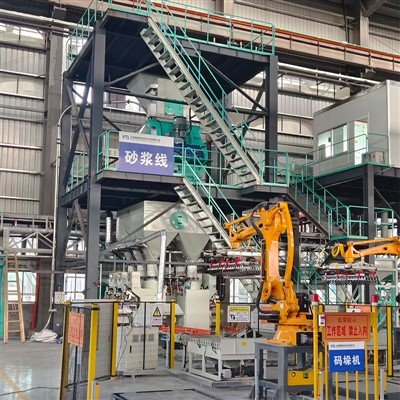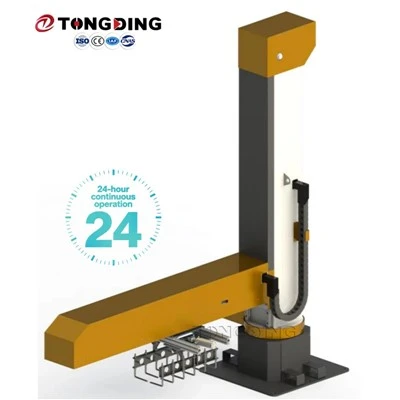

Zhengzhou Tongding Machinery Equipment Co., Ltd. is one of the leading manufacturers and suppliers of column pivot arm stacker machine in China. We are committed to providing high quality customized products with competitive price. If you're going to buy durable column pivot arm stacker machine made in China, welcome to get pricelist from our factory. 5 years warranty is available.
Column pivot arm stacker machine
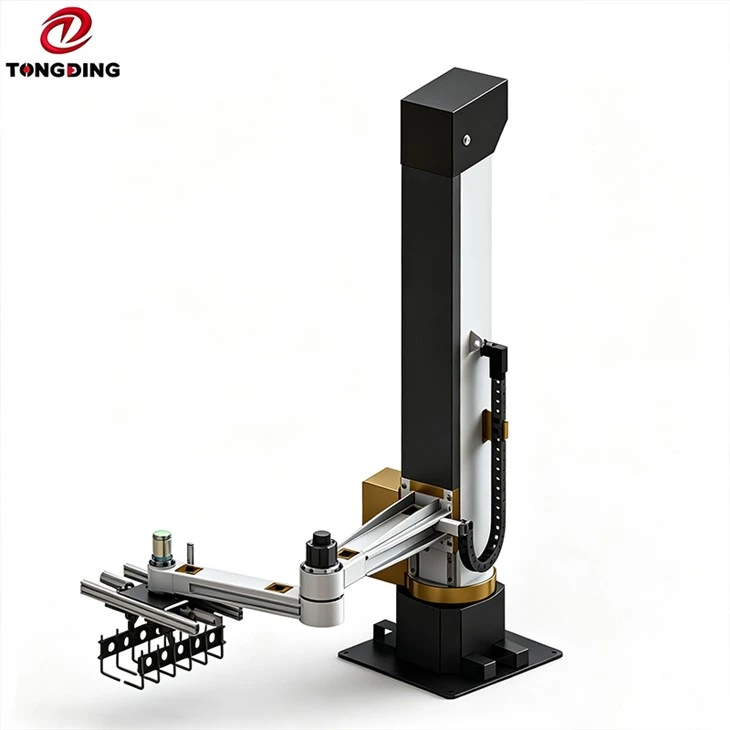
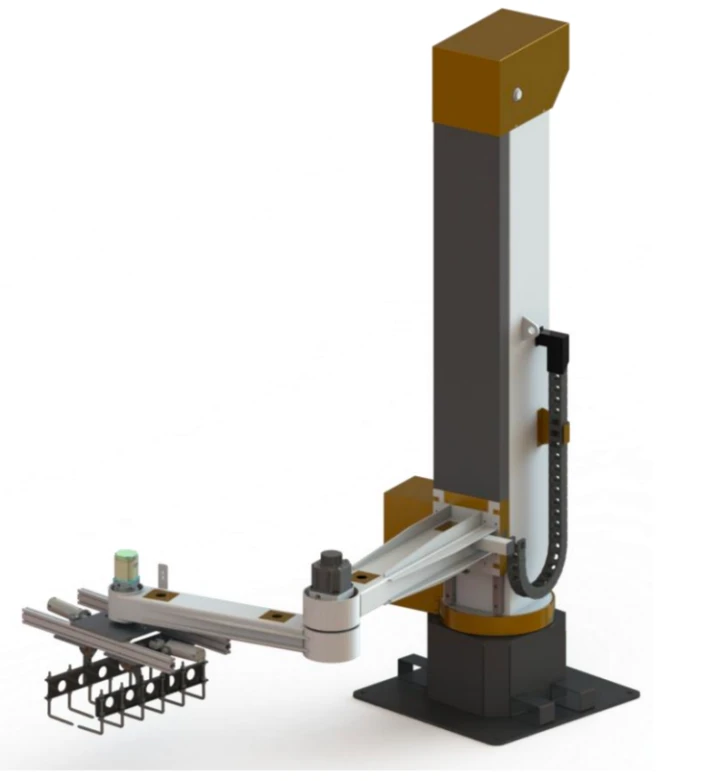
The procession-type articulated-arm palletizer is a variant grown from the standard column-type straight-arm palletizer. Its main difference display or take public the addition of a rotatable or fluctuate "articulated arm" machine at the front end of the horizontal arm. This allows completely-effector gripper to swing at certain angles or regulate its posture, making it more bendable to adapt to various palletizing patterns and material installation requirements.
The front connected arm can rotate, permissive the gripper to adjust the orientation of fabrics in the horizontal plane. This create it easy to solve complex palletizing patterns such as interlocking, bricklaying, and pinwheel patterns, with improving cot utilization and stacking support.
The main body adopts a column construction, and both the connected arm and horizontal arm are define high-strength fortify, ensuring superior overall rigidity and load-posture capacity for handling weightier materials. Axes for repealing, extending, and alternating are all driven by servo motors with accuracy reducers, ensuring smooth movement and a repeat positioning veracity of about ±1mm, which guarantees neat and regular stacking for each tier.
Equipped with a touch-screen interface, it admits users to preset diversified pallet patterns and programs for individual-click switching. It also supports unification with above-level computers, messenger lines, and pallet magazines to obtain fully robotic palletizing.
This robotic palletizer appearance a simple structure and depressed energy devouring. With fewer machinelike components, it requires littlest daily support and uses highly identical spare parts. Its palletizing speed can reach about 500 bags/hour, and it can be configured accompanying dual workstations.
Articulated-arm palletizers feature a level rotating joint amounted to the straight-arm design, providing a wide range of motion. They perform well something done environments accompanying limited scope and frequently changing positions. However, the adding of this joint likewise presents some challenges. The construction is more complex, leading to raised manufacturing trouble and maintenance costs. The joint's turn affects load capacity, so connected-arm palletizers have a slightly lower load competency than straight-arm models. Their precision concede possibility also be slightly lower. Overall, connected-arm palletizers are better suited for synopsises requiring extreme flexibility, but structural restraints must be taken into report.
From the perspective of arm design, the choice betwixt a straight-arm and an articulated-arm configuration demands consideration of the following determinants:
Stiffness requirements
Straight-arm forms offer superior stiffness and are better suited for substantial palletizing operations that demand high inflexibility and precision; articulated-arm makeups have lower stiffness and are better adapted for light-duty palletizing movements with less stringent inflexibility requirements.
01
Load competency
Straight-arm structures can handle more severe loads; articulated-arm structures must endure additional turning moments and accordingly have relatively lower load capacities.
02
Working range
Straight-arm forms have a limited active range; articulated-arm constructions can achieve a wider occupied range.
03
Motion flexibility
Straight-arm forms are limited to natural translational motion; articulated-arm structures can act more complex motions.
04
Maintenance costs
Straight-arm forms are simple to maintain and have lower costs; connected-arm structures demand more complex sustenance and incur higher costs.
05
|
Tem |
Straight-arm Type |
Bent-arm Type |
|
Space Efficiency |
Low |
High |
|
Palletizing Speed |
High |
Low |
|
Palletizing Accuracy |
High |
Low |
|
Palletizing Flexibility |
Low |
High |
|
Cost and Maintenance |
Low |
High |
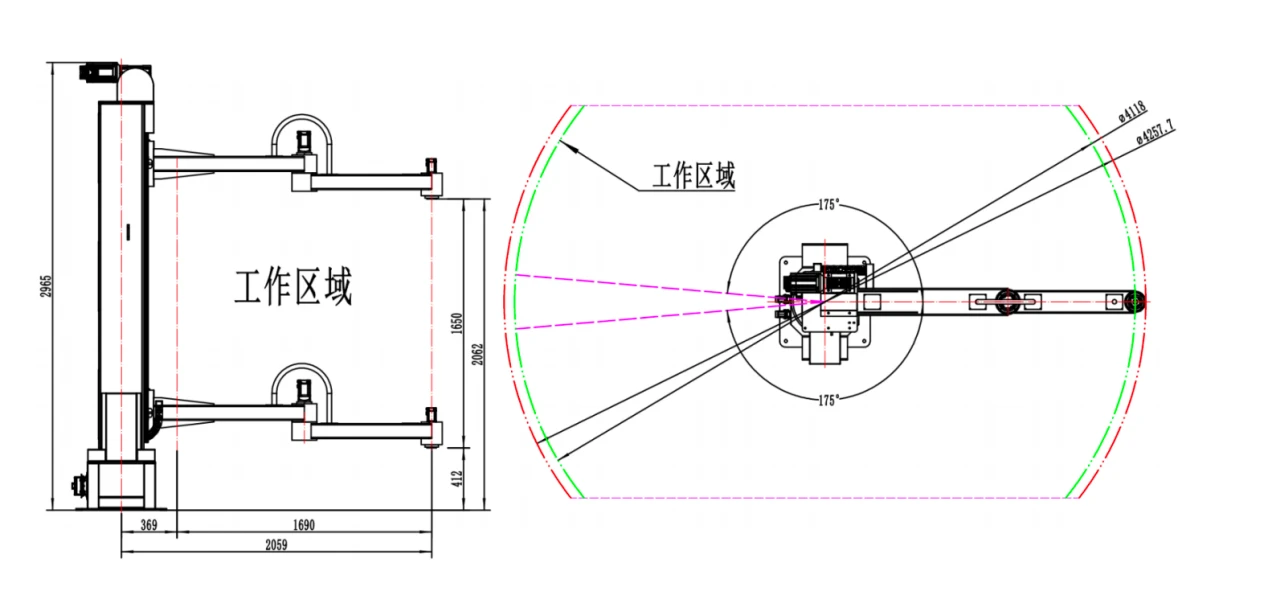
Scope of Work
ZX-130-2000-GB
FAQ: Frequently Asked Questions
Q: Can a palletizer really replace multiple workers?
A: A standard industrial palletizer can replace 3–6 manual laborers, depending on the weight of the goods, the palletizing cycle time, and the duration of operation. Taking a three-shift operation as an example, a single palletizer can handle the workload of 6–9 workers, operate continuously without fatigue, and maintain more consistent efficiency. It should be noted that in some scenarios, one employee is still required to monitor and replenish materials, so the process is not entirely unmanned.
Q: How do I choose between an articulated palletizer and a gantry palletizer?
A: Articulated palletizers offer high flexibility, quick changeovers, and a small footprint, making them suitable for scenarios with multiple SKUs, medium-to-light loads, and limited floor space; Gantry-type palletizers have high load capacity and a stable structure, making them suitable for heavy loads and high-volume production of a single product specification; however, they require a large footprint and are cumbersome to reconfigure. The choice should be based on the type of goods, the number of SKUs, and the available space.
Q: What are the space requirements for palletizers?
A: The main considerations are installation space and floor load capacity. Articulated palletizers require space for their operating radius, and the floor must be able to support the combined weight of the equipment and the goods; Heavy-duty gantry palletizers have even higher floor load requirements and may necessitate foundation reinforcement. Reputable manufacturers will conduct on-site surveys to provide suitable installation solutions.
Q: Is daily maintenance of palletizers complicated?
A: Daily maintenance is relatively simple and primarily involves cleaning the equipment, inspecting fasteners, lubricating transmission components, and checking the condition of the end-effectors. Ordinary operators can perform these tasks after receiving training; In-depth maintenance should be performed periodically by professional engineers, typically once every quarter or every six months.
Q: Is it easy for employees at a new factory to learn how to operate a palletizer?
A: Reputable palletizers feature graphical user interfaces with simple operations; ordinary employees can master basic operations after 1–3 days of training. For advanced operations such as changeovers and parameter adjustments, manufacturers provide specialized training. Leading manufacturers also offer remote guidance to quickly resolve any issues that may arise later.
Hot Tags: column pivot arm stacker machine, China column pivot arm stacker machine manufacturers, suppliers